 blog
Unique Grand Canyon Viewpoints: Private Tour Guide 2026
Table of Contents
- Why Private Tours Reach Grand Canyon Viewpoints Others Miss
- Overlooked South Rim Viewpoints Worth the Detour
- Building a Private Grand Canyon Tour Itinerary Around Light and Crowds
- Grand Canyon Private Tour from Sedona: Departure Logistics and Timing
- Accessibility, Families, and Photography: Matching Viewpoints to Your Group
- What to Look For When Booking a Private Grand Canyon Tour for 2026
- Frequently Asked Questions
Last Updated: September 13, 2026
Why Private Tours Reach Grand Canyon Viewpoints Others Miss
The Grand Canyon viewpoints most travelers photograph are the same handful of overlooks served by the shuttle system and main parking lots. A private tour changes which viewpoints are reachable, because the itinerary bends around your group rather than a fixed departure board. This guide examines the quieter South Rim overlooks, the timing that keeps them quiet, and how to plan a unique Grand Canyon viewpoints private tour 2026 around light, crowds, and your own pace.
Grand Canyon viewpoints are designated overlooks, pullouts, and rim access points along the South Rim and North Rim where visitors can see the canyon without descending into it. The South Rim sits at roughly 7,000 feet in elevation, which shapes everything from temperatures to how much walking feels comfortable (nps.gov).
The difference between a memorable rim day and a forgettable one is rarely the viewpoint itself, it is the hour you arrive and how many other vehicles arrive with you.
- Private vehicles reach trailheads and pullouts that shuttle routes skip
- Departure times flex around sunrise and sunset instead of a fixed schedule
- Groups can linger at one overlook or move quickly through several
The National Park Service manages access, parking, and seasonal closures across the rim, so a flexible itinerary matters more than a long list of stops.
Overlooked South Rim Viewpoints Worth the Detour
The South Rim's famous overlooks earn their reputation, but the rim road holds named pullouts that see a fraction of the traffic. These are the stops where a private vehicle earns its keep, and where knowing the actual name of the place matters, because a vague plan to 'find a quiet pullout' usually ends at a full parking lot.
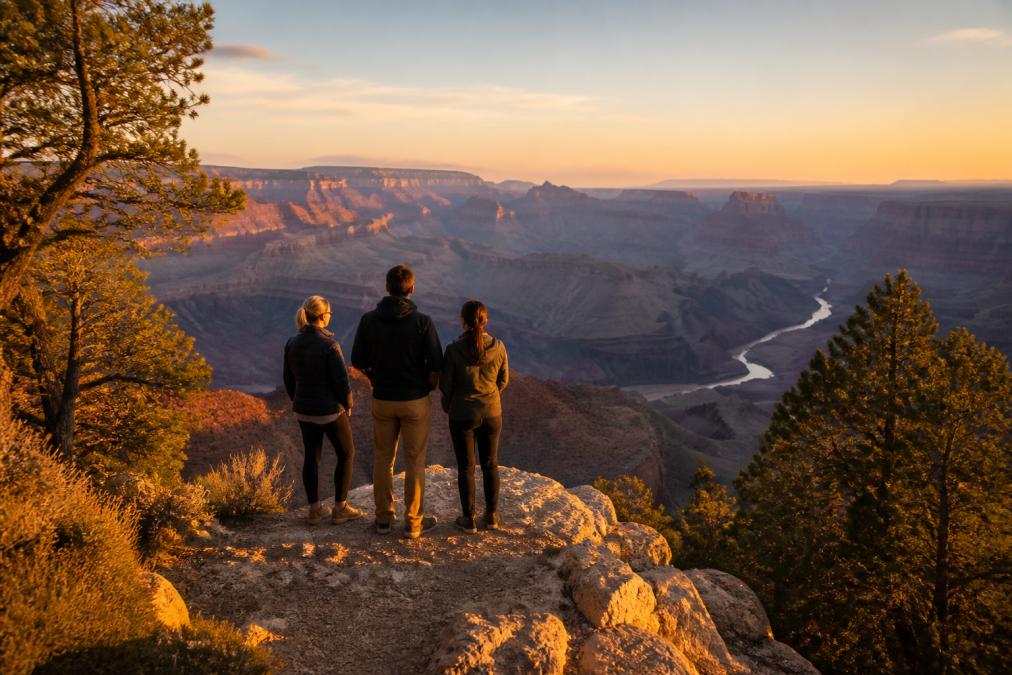
Named Stops Along Desert View Drive
Desert View Drive runs roughly 25 miles east from Grand Canyon Village to Desert View Watchtower, and the pullouts between developed areas are spaced far enough apart that most drivers pass them by (nps.gov). A few worth building into an itinerary:
- Yaki Point, reached via a side road off Desert View Drive rather than the main village shuttle corridor, with a broad view up and down the canyon. Access is managed seasonally, so a guide who checks current conditions is worth more than a printed map.
- Shoshone Point, a gated dirt access road leads to a short walk ending at a quiet rim point with no railings and no shuttle service. Because the gate is only open certain hours, this stop rewards local knowledge.
- Lipan Point, one of the widest panoramas on the South Rim, looking across to the Palisades of the Desert and over the river corridor. It sits far enough east that central-village crowds thin out noticeably.
- Moran Point, a short, paved walk from the parking area to a rim view that reads differently than the village overlooks because you are looking at a different stretch of canyon.
- Tusayan Ruin and Museum, not a rim overlook, but a worthwhile cultural stop along the same drive, with a short interpretive trail through an ancestral Puebloan site.
A private itinerary can work three or four of these in the time a fixed route spends loading and unloading once at a single hub.
Quiet Westbound Overlooks Near Tusayan
West of the main village, the rim road passes smaller overlooks facing different sections of the canyon than the eastern stops. Travelers staying in Tusayan are positioned well for these, since the drive from the south entrance is short. Morning light hits this stretch differently, making it a useful second stop rather than a repeat of the same view.
What 'Off the Beaten Path' Actually Means Here
A word of realism: on the South Rim, there is no truly secret overlook reachable by car. What exists is a hierarchy of crowding. The village hub, Mather Point and Yavapai Point, absorbs most first-time visitors because the shuttle system and main parking lots concentrate there. Move east or west along the rim road and the ratio flips: fewer vehicles, more rim per person.
That is the honest version of the 'unique viewpoints' promise. A private tour does not unlock a hidden gate; it lets you spend your limited hours at the quieter end of a known spectrum, at the hour when that end is quietest. For the full picture of what a private day can include, see the private Grand Canyon tours page.
North Rim: A Different Canyon Entirely
The North Rim sits roughly 1,000 feet higher than the South Rim and sees a small fraction of the visitation, largely because it is a much longer drive from the gateway towns and is closed by snow for roughly half the year, typically from late fall through mid-spring (nps.gov). When open, the views are genuinely different, you look across at the South Rim rather than standing on it, and the forested approach feels nothing like the desert-edged South Rim corridor.
For most travelers basing in Sedona, Flagstaff, Williams, or Tusayan, the North Rim is not a practical day destination; the drive alone consumes the day. A South Rim itinerary is the realistic plan for a single-day private tour.
Building a Private Grand Canyon Tour Itinerary Around Light and Crowds
A private Grand Canyon tour itinerary works best built backward from light rather than forward from a list of stops. The canyon's appearance shifts through the day, and the same overlook can look flat at noon and dramatic two hours later.
Sunrise, Sunset, and the Hours Between
Sunrise and sunset draw the largest photography crowds to the most accessible overlooks. The trade-off is real: the light is best when the prime spots are busiest. A workable compromise is one golden-hour window at a quieter pullout, with the middle of the day spent on scenic drives, visitor center stops, and short rim walks. Mastering the art of avoiding tourist crowds requires similar strategic timing in other vast natural landscapes, such as when navigating the serene shorelines of Lake Tahoe.
Midday has its own advantages. Shadows shorten, distant formations read more clearly, and the developed areas are easier to move through.
| Time Window | Light Quality | Crowd Level | Best Use |
|---|---|---|---|
| Sunrise | Warm, low-angle | High at main overlooks | Quiet pullouts, photography |
| Mid-morning | Clear, even | Moderate | Scenic drive, short walks |
| Midday | Flat, harsh | High in village area | Visitor center, dining, rest |
| Late afternoon | Warming again | Building | Secondary overlooks |
| Sunset | Best color | Highest | One planned viewpoint only |
Grand Canyon Private Tour from Sedona: Departure Logistics and Timing
A Grand Canyon private tour from Sedona involves a longer drive than departures from Flagstaff, Williams, or Tusayan, which changes how the day should be structured. Sedona sits south of the canyon, so the approach adds meaningful travel time each way.
That distance is why a Sedona departure benefits from an early start: leaving before dawn puts a group at the rim for morning light rather than arriving after it. Flagstaff departures are closer and can leave later without losing the best window. Williams and Tusayan sit closest to the south entrance, making them the most flexible for sunrise or sunset timing.
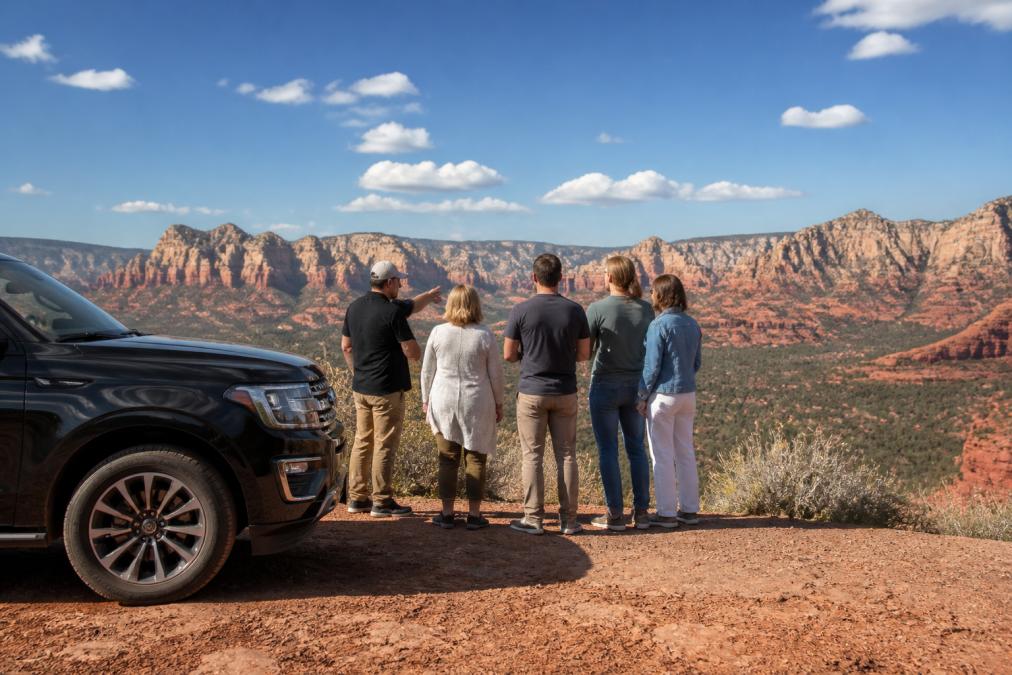
Door-to-door pickup matters here. A private operator collects a group from its hotel or bed and breakfast, removing the parking question at the rim entirely. Grand Canyon Journeys runs 100% private tours with pickup across Sedona, Flagstaff, Williams, and Tusayan in custom Ford Transit vehicles, so departure time is set by the group rather than a fixed schedule.
Full-day journeys include park fees and dining at the historic El Tovar, which removes two logistical decisions from the day.
Accessibility, Families, and Photography: Matching Viewpoints to Your Group
Not every overlook suits every group, and matching the two is where a private itinerary outperforms a fixed route. The three groups below are where the match matters most.
Accessibility-Focused Stops
The South Rim is the more developed rim, and that development is an accessibility advantage. A number of viewpoints and rim trails are paved and relatively level, which suits wheelchairs, walkers, and travelers who prefer not to walk far. The Rim Trail between the village viewpoints is the clearest example: paved, mostly flat, and connecting several overlooks so a group can see more than one panorama without reparking.
Two practical points that generic advice misses:
- Paved does not mean flat. Some rim paths have grades and curb transitions that matter for a manual wheelchair. Ask specifically about grade and surface, not just whether a path is paved.
- Shuttle-free access changes the calculus. Some viewpoints are served only by shuttle for part of the year, which complicates mobility planning. A private vehicle can reach viewpoints with their own parking areas, which is often the simpler path for a group with mobility needs.
A route built around step-free rim access can still deliver panoramic views; it simply requires knowing which overlooks have paved approaches and which do not. Families benefit from the same knowledge, since a seven-year-old and a traveler with a walker often need the same things: short distances, seating, and shade.
Family-Friendly Stops
Younger children do best with short walks, frequent breaks, and viewpoints with room to move without a railing crowd pressing in. The village area works well because restrooms, water, and food are close together. The trade-off is that the village is also the busiest part of the rim, which is where timing, early morning or shoulder hours, does more for the experience than any particular stop.
A private vehicle also solves a family problem that fixed routes cannot: the mid-day reset. When a child is done, the group can leave. There is no waiting for a return departure.
Photography-Focused Itineraries
A photography-focused itinerary is built differently from a sightseeing one:
- Fewer stops, longer dwell times. Two overlooks with an hour each beats six with ten minutes each, because light changes and compositions take time to find.
- Directional light matters more than 'golden hour.' A viewpoint facing east is a sunrise location; one facing west is a sunset location. A guide who knows the compass orientation of each stop can sequence them so the light works with you rather than against you.
- Tripod-friendly surfaces. Some rim overlooks have flat, stable viewing areas; others are sloped rock with foot traffic. If tripod work is the goal, say so when booking.
- Weather as subject. The canyon's most photographed conditions, partial cloud, storm light, fog filling the inner gorge, are also the least predictable. A flexible private schedule is the only way to chase them.
Photographers should say so when booking. If your group includes both photographers and non-photographers, agree in advance on how long the group will hold at each stop, a private itinerary can accommodate both, but only if the plan says so.
What to Look For When Booking a Private Grand Canyon Tour for 2026
Ask three questions before booking any private tour: does the operator run exclusively private departures, is pickup included from your lodging, and does the itinerary adjust to your group's pace. Operators that answer yes to all three are structured differently from those selling a fixed route with a private label.
Park entry fees are worth clarifying in advance. So is the cancellation policy, since canyon weather and road conditions can shift plans quickly. Grand Canyon Journeys offers a full refund when a booking is canceled at least 24 hours before departure.
Group size limits matter for a different reason. A private vehicle with flexible seating lets a group spread out, which matters on a long day with kids or older travelers.
Language support is another practical filter. Grand Canyon Journeys provides both English and German-speaking guides, which matters for international visitors who want the geology and cultural history explained in their own language.
Frequently Asked Questions
What are some hidden gems and secluded viewpoints at the Grand Canyon South Rim?
Beyond Mather Point and the visitor center, the South Rim holds quieter overlooks along Desert View Drive and west of the main village. Stops like Lipan Point, Moran Point, and Shoshone Point reward those willing to drive a few extra minutes. A private tour can time your arrival at these grand canyon viewpoints outside peak hours, when tour groups have moved on and the canyon rim feels calm and personal.
What is the best viewpoint for sunsets in the Grand Canyon?
Hopi Point and Mohave Point along Hermit Road face west and catch the full sweep of sunset color across the canyon. Yavapai Point also works well and sits closer to the village. On a private Grand Canyon tour itinerary, your guide can adjust timing and location based on cloud cover and season, so you are not locked into one spot on a fixed schedule.
How does a Grand Canyon private tour from Sedona or Flagstaff work?
Guests are picked up at their hotel or B&B in Sedona, Flagstaff, Williams, or Tusayan in a custom Ford Transit van, then driven to the South Rim with stops chosen around the group's interests. Park entry fees are included, and the pace stays flexible. Full-day journeys can include dining at the historic El Tovar. Cancellations at least 24 hours before departure receive a full refund.
What should I look for when booking a private Grand Canyon tour for 2026?
Confirm the tour is genuinely private with no shared vehicle, check whether park entry fees and hotel pickup are included, and ask how the itinerary adapts to weather, crowds, and your group's pace. Look for guides who speak your language and reviews you can verify. Grand Canyon Journeys offers English and German-speaking guides and door-to-door pickup from Sedona, Flagstaff, Williams, and Tusayan.
The hardest part of planning a Grand Canyon day is not choosing a viewpoint. It is building a route that matches your group's pace, your available light, and your tolerance for crowds, all at once. Grand Canyon Journeys handles that planning with 100% private tours, door-to-door pickup from Sedona, Flagstaff, Williams, and Tusayan, custom Ford Transit vehicles with flexible seating, and park fees included on full-day journeys. Check availability and build an itinerary around your group's timing.