 listicle
Romantic Hiking Trails for Couples in Grand Canyon
Table of Contents
- Why the Grand Canyon Works for a Couples Hike
- Rim Trail: The Easiest Romantic Hiking for Couples
- Easy Day Hikes for Couples: South Rim Picks
- What to Pack for a Grand Canyon Day Hike
- Best Sunset Spots on the South Rim for Couples
- Strenuous vs Moderate Trails: Choosing Your Pace Together
- Safety, Heat Exhaustion, and Wilderness Awareness
- How a Private Tour Elevates a Romantic Canyon Day
- Frequently Asked Questions
Last Updated: September 16, 2026
Why the Grand Canyon Works for a Couples Hike
The Grand Canyon rewards couples who slow down. At roughly 7,000 feet, the South Rim stays far more forgiving than the inner canyon below, so a shared walk along the rim can stay comfortable while the scenery does the heavy lifting. This guide from Grand Canyon Journeys covers the trails, timing, and logistics that turn a canyon visit into something genuinely romantic.
Rim Trail: The Easiest Romantic Hiking for Couples
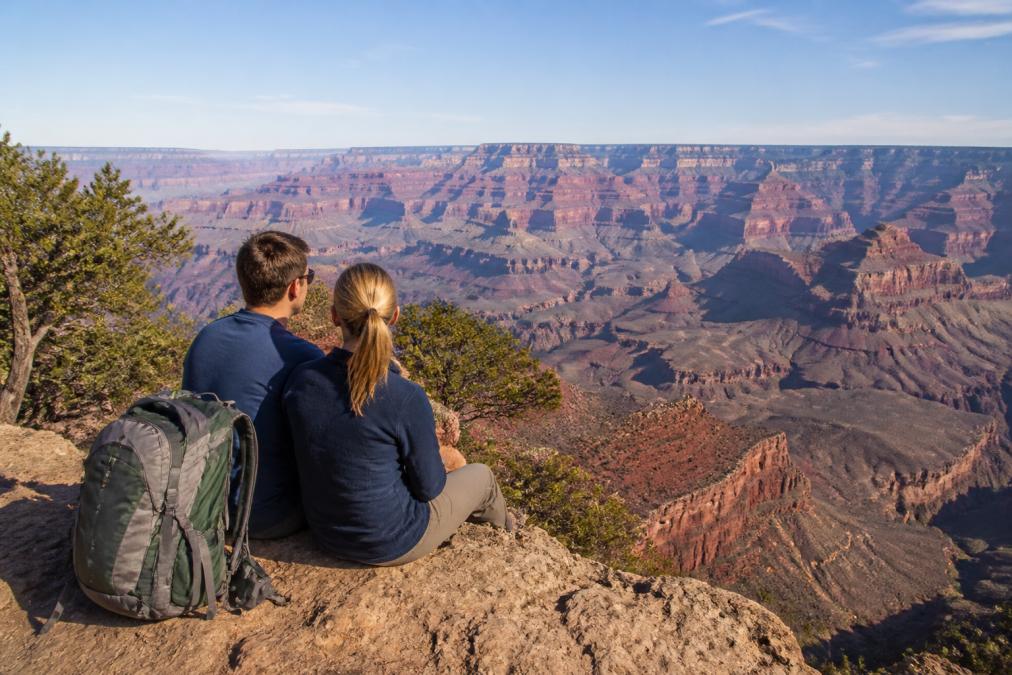
The Rim Trail is the best introduction to romantic hiking at the Grand Canyon: a paved, mostly flat path following the South Rim for miles, connecting overlooks with almost no elevation gain. Couples can walk as far as they like and turn around whenever they choose.
Trailhead Access and Shuttle Service
The park's free shuttle connects major trailheads, viewpoints, and parking areas, removing the logistics headache: park once, walk the rim, and catch a shuttle when legs get tired. Trailhead parking fills early in peak season, so arrive before mid-morning.
Scenic Overlooks Along the Way
The Rim Trail strings together some of the park's most photographed viewpoints, each with a different composition that keeps the walk visually fresh. Rather than rushing from marker to marker, claim one quiet bench, sit for twenty minutes, and let the canyon change around you.
Easy Day Hikes for Couples: South Rim Picks
Easy day hikes for couples on the South Rim share three traits: modest elevation gain, clear turnarounds, and big payoff. These are the trails to choose when you want to descend below the rim without committing to a strenuous climb back.
- Trail difficulty rating: easy. Wide, maintained paths with gentle grades and frequent switchbacks.
- Roundtrip distance: short. Most easy options run under three miles roundtrip, ideal for a half-day.
- Turnaround flexibility. You can stop at any point and reverse without missing a landmark.
Three Easy South Rim Trails Worth Your Morning
Trail of Time. A 1.3-mile one-way interpretive walk near the Village that lays out the canyon's geology along a marked timeline. Paved, essentially flat, and dotted with benches, it is the easiest place on the South Rim to hold a conversation while you walk.
Trail Difficulty Ratings and Elevation Gain
Descending feels effortless; the climb back is where the work lives. Even an easy-rated trail involves elevation gain on the return, and at 7,000 feet the air is thinner than most visitors expect.
| Trail Type | Typical Grade | Elevation Gain | Best For |
|---|---|---|---|
| Rim Trail | Flat to gentle | Minimal | Strolling, sunset, photos |
| Easy inner-canyon | Moderate descent | Several hundred feet | Half-day adventure |
| Moderate | Steeper switchbacks | More demanding | Fit, confident hikers |
| Strenuous | Steep, exposed | Significant | Experienced hikers only |
A Couples Compatibility Check Before You Pick
Most trail guides assume both partners hike at the same level. In reality, one person is usually fitter, faster, or more confident on loose rock, and that difference decides whether the day feels romantic or resentful. Answer three questions together first:
- How does the less confident hiker feel about exposure? Trails with drop-offs beside the path are the ones that turn a relaxed walk into a white-knuckle march for one partner. The Rim Trail and Trail of Time have almost none; inner-canyon switchbacks have more.
- Can both of you climb for 30 minutes without stopping? If not, stay on the rim or cap your descent at the first rest house. There is no shame in this, and the views do not require the climb.
- Who is carrying the pack? If one person is hauling all the water, that person is working harder on the return. Split the load so the slower hiker is not also the heavier one.
What to Pack for a Grand Canyon Day Hike
What to pack for a Grand Canyon day hike comes down to three priorities: water, layers, and support for your feet and knees. The desert swings hard between sun and shade, and the rim's elevation means mornings can feel cool even in summer.
Hydration, Layered Clothing, and Trekking Poles
Hydration is non-negotiable. Water stations are limited and unreliable on many trails, so carry more than you think you need and treat refill points as a bonus, not a plan. Layers handle the temperature swings: a light base, an insulating mid-layer, and a wind shell cover most conditions. Trekking poles take pressure off the knees on steep descent and steady your footing on loose rock.
- Two liters of water per person, minimum
- Salty snacks and quick energy food
- Sunscreen, hat, and sunglasses
- Layered clothing and a wind shell
- Trekking poles for steep sections
- Sturdy shoes with grip
Best Sunset Spots on the South Rim for Couples
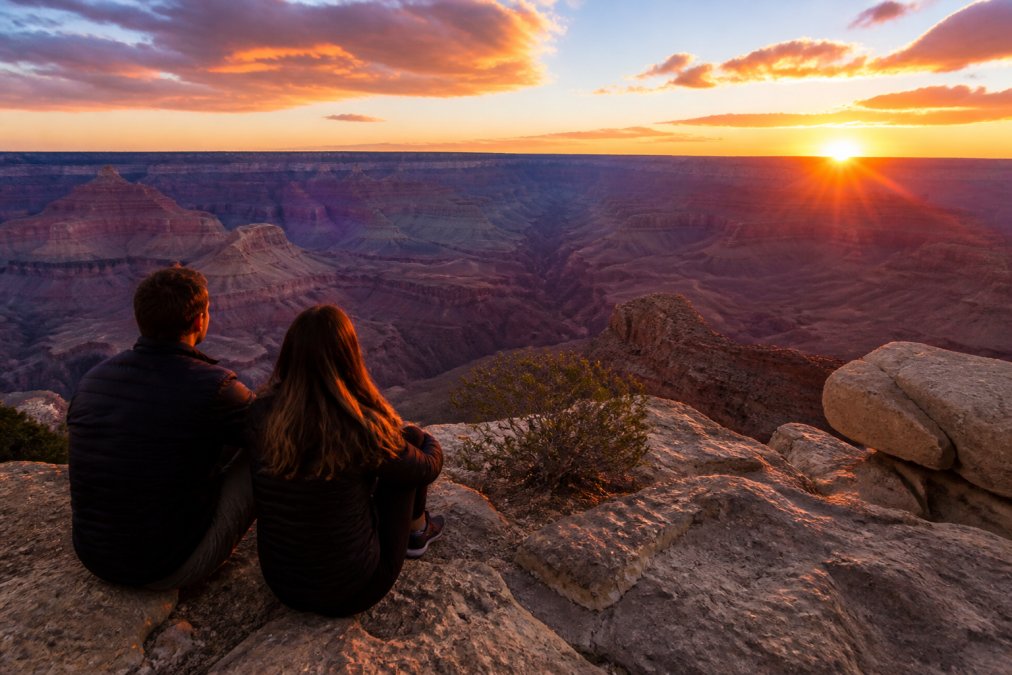
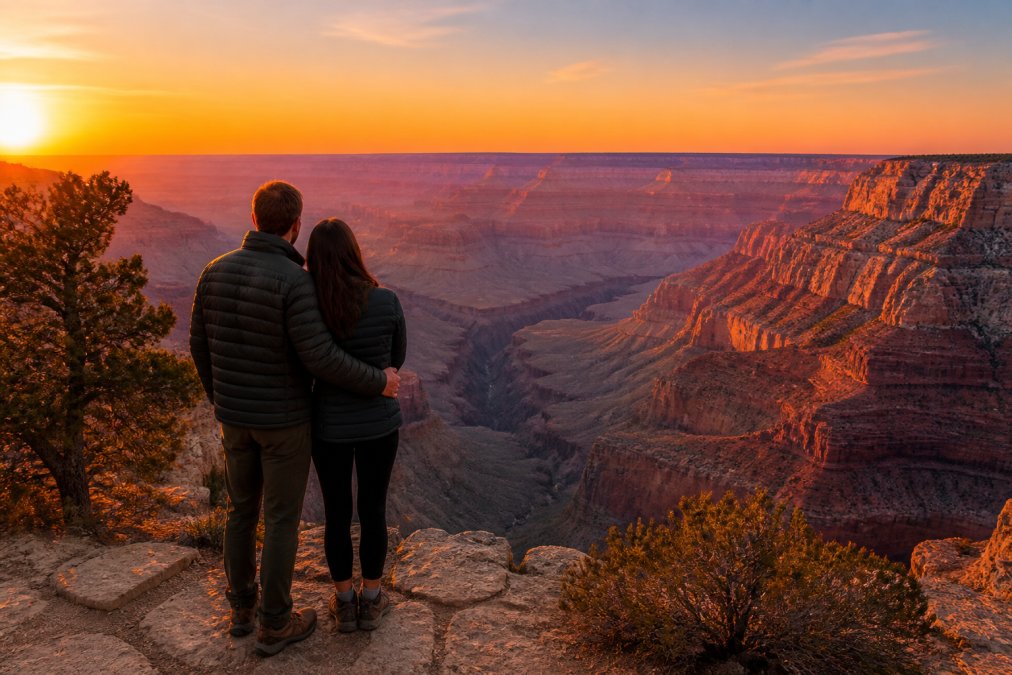
The best sunset spots on the South Rim for couples are west-facing overlooks with room to spread out. Arriving 45 minutes early secures a good vantage point and lets you watch the light change gradually.
Strenuous vs Moderate Trails: Choosing Your Pace Together
Strenuous and moderate trails differ less in scenery than in commitment. Both deliver panoramic views and quiet canyon moments; the real question is how much climbing you want on the return leg and how well both partners handle sustained uphill effort at elevation.
What Moderate Actually Means Here
A moderate South Rim trail typically means a maintained path with switchbacks, a descent of a few hundred feet, and a return climb of 30 to 60 minutes for most casual hikers. You are rarely more than a mile from the rim; the work is real but bounded.
The Turnaround Rule That Saves Relationships
Agree on a turnaround time before you start, not a turnaround point. Time is the only metric both partners can track without arguing about distance. Set a clock, say, 90 minutes of descent, and when it hits, turn around together, whether or not you reached the landmark you had in mind.
Matching Pace Without One Person Waiting
A common pattern is the fitter partner surging ahead and stopping to wait, turning the hike into sprints and stalls. A steadier approach: let the slower hiker set the pace and have the faster hiker carry more of the shared weight, water, snacks, the camera bag. The faster partner gets a real workout, the slower partner is not chasing, and you stay within sight of each other.
Choosing Together, Not for Each Other
The healthiest way to pick a trail is to have each partner name their honest limit out loud before you look at a map, not the limit you wish you had, but the one you actually have that day. Sleep, altitude, and how recently you have hiked all move that number.
Safety, Heat Exhaustion, and Wilderness Awareness
Heat exhaustion is the most common serious problem for canyon hikers, and it is almost entirely preventable. The inner canyon runs dramatically hotter than the South Rim, so a comfortable 7,000-foot morning can mask brutal conditions a few hundred feet down (Weather and Climate). Watch for dizziness, nausea, headache, and stopped sweating.
- Turn around at the first sign of heat exhaustion, not the second.
- Rest in shade and drink water with electrolytes.
- Never split up on a trail if either person feels unwell.
- Check current conditions and closures before you go.
How a Private Tour Elevates a Romantic Canyon Day
A private tour removes the friction that quietly ruins romantic days: parking battles, shuttle timing, navigation stress, and the feeling of being herded. Grand Canyon Journeys offers 100% private tours with door-to-door pickup from Sedona, Flagstaff, Williams, and Tusayan, so couples start the day relaxed instead of frazzled.
Frequently Asked Questions
Are there easy hiking trails for couples at the South Rim?
Yes. The Rim Trail runs roughly 13 miles along the South Rim and stays mostly flat, so couples can walk as far as they like and turn around whenever they want. The stretch between Village Route transfer points and Hermits Rest offers panoramic views without steep descent. Bright Angel Trail's first switchbacks also work for a short taste of the inner canyon, though that section is moderate rather than easy.
What should couples pack for a day hike at 7,000 feet elevation?
The South Rim sits near 7,000 feet, so layered clothing matters even in summer. Bring a base layer, a light insulating layer, and a windproof shell. Add at least one liter of water per person per hour of hiking, high-energy snacks, sunscreen, a hat, and trekking poles if you plan any steep descent. Sturdy shoes with grip are essential on dusty switchbacks.
How do I plan a romantic day trip to the South Rim?
Start early to catch soft morning light and avoid midday heat, then pick one easy day hike such as a Rim Trail segment. Break for lunch, rest during the hottest hours, and save sunset for a scenic overlook like Hopi Point or Yavapai Point. A private tour with door-to-door pickup from Sedona, Flagstaff, Williams, or Tusayan removes driving and parking stress so you can focus on each other.
Is it better to hike or take a private tour for a romantic experience?
Both work, and they pair well. Hiking gives you quiet time together on the trail, while a private tour handles logistics, timing, and comfortable transport in an upgraded Ford Transit van. Many couples hike a short Rim Trail section in the morning, then let a guide manage the sunset overlooks and dinner timing. Grand Canyon Journeys offers day hiking only, so plan any hiking as its own separate product.
Planning a romantic canyon day means balancing ambition with comfort, and the couples who enjoy it most are the ones who choose a pace they can share. Grand Canyon Journeys builds private, flexible itineraries with door-to-door pickup, included park fees, and guides who know when to linger and when to move. Check Availability and let a private tour handle the details so the two of you can focus on the view.